Alleima offers product-specific carbon footprint data for its manufactured rock drill steel products through Life Cycle Assessments (LCA). Alleima’s LCA model has been reviewed by IVL Swedish Environmental Research Institute.

a group of grey objects

Alleima is committed to producing industry-leading materials that excel in quality, performance, and carbon footprint. With our third-party reviewed LCAs, customers can easily compare our products against alternative materials and make informed choices. By choosing material with lower carbon footprints, customers can significantly reduce the overall climate impact of their final products and accelerate progress toward their climate reduction targets.

Continued carbon footprint reductions on Rock Drill Steel products

Updated LCA Model with production data from 2024 shows further emission reductions.

Back in January 2024, Alleima took an important step in its sustainability journey by presenting its first Life Cycle Assessments (LCAs). Rock Drill Steel (RDS) was the first product category to be assessed, and the Sanbar®64 product became the benchmark for evaluating carbon footprint. These initial LCAs were based on 2022 production data, and the results were striking: when comparing supplier-specific data with generic database values for alloys and energy, the carbon footprint was 57% lower.

Fast forward to 2025, and the LCA model was updated with production data from 2024, enabling new carbon footprints for the same RDS products. The results continue to show improvements, underscoring the value of regularly updating the LCA model with current data, to accurately reflect ongoing sustainability efforts. For some products, a further reduction of up to 45% has been achieved compared to the 2022 baseline.

a graph of carbon footprint

Looking ahead

solar panels on a roof

These results demonstrate Alleima’s commitment to transparency and continuous improvement in product carbon footprint and is a great example of how LCA can be used to assess the effectiveness of our sustainability efforts. By refining models, optimizing energy use, and collaborating with suppliers, we’re not only reducing our environmental impact; we’re also setting a benchmark for responsible production in the steel industry.

Three key factors driving the continued improvement

smoke and smoke coming out of a factory

1. More accurate steelmaking emissions

One of the most impactful updates to the LCA model was a refinement in how emissions from the Electric Arc Furnace (EAF) are calculated. By better aligning the model with actual CO₂ emissions from steelmaking and chemical composition, the carbon footprint from this stage of production has been significantly reduced.

solar panels and wind turbines in front of a power line

2. Cleaner energy mix

Energy remains the second-largest contributor to the product carbon footprint of Alleima products, following alloys. When analyzing the updated RDS results, it became clear that a major reduction can be attributed to changes in fuel usage. Between 2022 and 2024, the use of biogas in production increased notably, which in turn reduced the reliance on liquefied natural gas (LNG). This shift has had a direct and positive impact on the overall carbon footprint of the products.

a hand holding a yellow and black device

3. Integration of Supplier-Specific Data

Over the past year, Alleima has made a joint effort to enhance the LCA model by continuously integrating supplier-specific carbon footprint data. This is especially important for alloys, which typically account for 50–75% of the total product carbon footprint for RDS products, depending on chemical composition. Materials such as silicon and aluminum alloys, which were previously assessed using generic data, now benefit from more accurate, supplier-specific values.

How does the energy and sourcing of raw materials impact the carbon footprint?

Fossil-free Energy

Alleima’s operations in Sweden benefit from the country’s predominantly fossil-free electricity mix. This provides a significant advantage in maintaining lower carbon emissions compared with regions where energy production relies heavily on fossil fuels.

a group of icons with text

A customers of Alleima, Epiroc Drilling Tools, emphasize the importance of stepping away from using generic data since these impacts tend to be higher, less representative, and less reliable.

"We need to have accurate and reliable data from our suppliers to present ourselves as reliable" - Michael Jansson, General Manager at Epiroc Drilling Tools

a person in a suit

Michael Jansson, General Manager at Epiroc Drilling Tools

Raw materials

The primary factors contributing to the carbon footprint in stainless steel production might surprise you. It's not just the melting process of the material; it’s primarily the mining of alloys and the processing of them into virgin alloys. Therefore, it is important to be careful when selecting raw materials suppliers.

There is a significant difference between a supplier with verified low carbon emissions and those relying on generic industrial data. Presently, not all raw material suppliers have a product specific carbon footprint to share, but Alleima encourages all suppliers to verify their production processes. The future aspiration for Alleima is to only buy from producers that can provide verified Life Cycle Assessment (LCA)

Melting of the material

Also, the choice of melting practice influences the carbon emissions. At Alleima we use more than 90% recycled material when melting our rock drill steel products in our electric arc furnace (EAF).

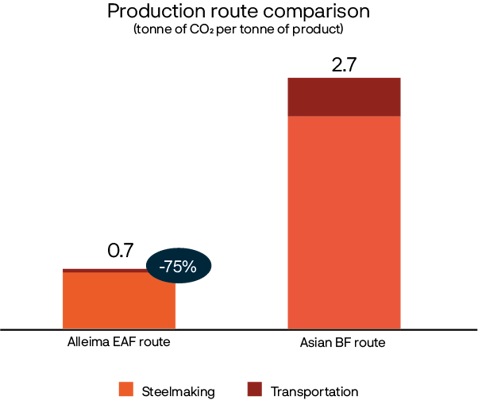
The Electric Arc Furnace (EAF) is a well-established production process utilized in Europe and the US and has been used for decades. However, in other parts of the world, blast furnaces (BF) remain in operation. BF mainly relies on primary resources like iron ore, which require decarbonization and will result in significantly higher carbon emissions - typically 4-7 times greater compared to using an EAF.

Another factor to consider is that the two production routes operate on different energy sources. The blast furnace primarily relies on coke as fuel for the melting process, while the electric arc furnace operates using electricity. The energy intensity of the EAF is estimated to be one-eighth that of the production from iron ore, a distinction that is reflected in the carbon footprint of the processes.

Transportation

Reducing the distance between the steel producer and the customer can lead to a significant reduction in the carbon footprint associated with transportation. For instance, transporting 1 tonne of steel from the Alleima Sandviken site to central Europe results in a carbon footprint approximately one-sixteenth of the carbon emissions produced when transporting 1 tonne of steel from Asia to central Europe.

Additionally, the strategic proximity of our Sandviken site to the port of Gävle further reduces the carbon footprint associated with overseas transportation. With only a short distance between our production facilities and the port, long-haul transport via truck is avoided and thereby, carbon emissions linked to domestic logistics are minimized.

a screenshot of a graph

Featured stories

Feature story 7 July 2024
a close-up of several round metal rods

New low carbon footprint data shows Alleima is a leader in stainless steel sustainability

Insights from Alleima.

Feature story 29 January 2024
Delivering reviewed carbon footprint data for rock drill steel products

Delivering reviewed carbon footprint data for rock drill steel products

Insights from Alleima.

Feature story 5 September 2023
a group of people walking in a building

LCA – a necessity for the future of sustainable industry

Insights from Alleima.

Q&A

To provide reliable and solid product carbon footprints, the Alleima LCA model has been reviewed by IVL – Swedish Environmental Research Institute (IVL), which has long experience and a high level of competence within this field. IVL has also supported in the development of the data management and the development of the model.

The LCA results for RDS products have been developed in line with ISO 14067 (ISO 14040/ISO 14044 family) which is the most common, globally accepted LCA standard.

One of the key advantages of LCA is that it pinpoints the areas within a product’s lifecycle with the most significant environmental impact. With this information at hand, we can then specifically target areas for improvement, effectively reducing the product’s carbon footprint. By analyzing resource usage, for example, it is also possible to optimize the utilization of resources, such as switching to materials with lower carbon footprints.

1. Identifying hotspots

Identifying environmental hotspots within a product’s lifecycle provides valuable insight on where the greatest impacts occur, such as during material production, energy use, transportation or end-of-life. With this insight, improvement efforts can be directed toward the stages that contribute most to the overall product carbon footprint, enabling more effective and measurable climate reductions.

2. Resource preservation

By mapping how materials and energy are consumed throughout the lifecycle, an LCA can reveal opportunities to optimize resource use. This may involve reducing waste, improving process efficiency, or selecting alternative materials with lower climate impact. Such optimizations support long-term resource preservation and help strengthen environmental performance.

3. Costs savings

Many of the efficiency opportunities identified through LCA can also lead to potential cost savings. More efficient processes tend to consume fewer resources, require less energy, and generate less waste, all of which contribute to reduced operational expenditures.

4. Competetive advantages

Transparent and reliable environmental data enhance credibility with customers and other stakeholders. Companies that can demonstrate verified climate performance gain a competitive edge, especially as sustainability requirements become increasingly important in procurement. By providing clear insights into the environmental impact of products, LCA contributes to stronger customer relationships and supports stakeholders in reaching their climate targets.

Contact your Alleima sales representative.

Need to know more? We're here to help