
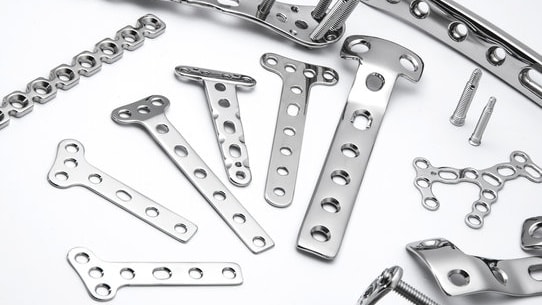

Medical implants in orthopaedic, cardiovascular, and dental applications face extreme conditions inside the human body, constant mechanical loads and a chemically aggressive environment.
To remain safe and reliable over a patient’s lifetime, materials must be biocompatible, stable, strong, fatigue- and corrosion-resistant, and highly durable. Failures can lead to fractures, wear debris that causes inflammation, or corrosion that releases harmful ions.
We develop high-purity stainless steels engineered to meet these demands and ensure long-term implant performance.
The role of high-performance stainless steel
One of the most widely used materials for implants is 316L stainless steel, a molybdenum-bearing alloy renowned for its corrosion resistance and formability. The low carbon content (<0.03%) prevents carbide precipitation, while chromium (17–19%) forms a robust passive film that protects against rusting. Molybdenum (2–3%) enhances resistance to pitting and crevice corrosion, and nickel (13–15%) stabilizes the austenitic structure, improves toughness, and ensures non-magnetic behavior, important for MRI compatibility.
While standard 316L offers strong performance, many implant applications require even higher purity and more controlled microstructure to meet stringent regulatory and clinical demands.
Engineered purity for critical implants
Alleima® 316LVM (“316L Vacuum Melted”) is our high-purity variant of 316L stainless steel, developed to meet the strictest requirements for implant-grade materials. Produced through electric arc melting followed by vacuum arc remelting (VAR), 316LVM achieves:
-
Exceptionally low impurity levels
Reduced oxygen, sulphur, and phosphorus content minimises non-metallic inclusions and brittle phases. -
A homogeneous, inclusion-free microstructure
Essential for high fatigue strength and long-term structural integrity in load-bearing implants such as hip and knee components, trauma fixation devices, and spinal rods. -
Ferrite-free composition
Eliminating ferrite increases corrosion resistance and stability, particularly in chloride-rich environments inside the body.
The result is a material designed to withstand decades of mechanical cycling, stress, and biological exposure, without compromising patient safety.
Surface finishing is essential for biocompatibility and wear resistance
Even with a superior alloy, surface condition plays a decisive role in implant performance. A smooth, defect-free surface:
-
reduces friction between articulating components
-
decreases wear particle generation
-
minimises inflammation risks
-
eliminates crevices where corrosion or bacterial growth can initiate
Vacuum-melted materials like Alleima® 316LVM provide a significant advantage because their high purity and fine microstructure make it easier to achieve consistent, high-quality polishing, electropolishing, and passivation.
Rigorous testing and global standards compliance
Alleima® 316LVM is produced to meet the requirements of:
-
ASTM F138 / F139
-
ISO 5832-1
-
FDA guidelines for implant materials
Every heat undergoes comprehensive quality control, including:
-
advanced metallurgical analysis
-
chemical composition verification
-
tensile and hardness testing
-
specialised corrosion tests, including intergranular corrosion assessments per ASTM/ISO standards
Our customers rely on consistent, repeatable quality and we ensure that every batch meets the demanding specifications required for implant applications.
Download the white paper for deeper insights or visit our medical strip steel page to explore how Alleima can support the next generation of medical implants: