
The microstructure is a major difference between our fine-carbide steels and other knife steels such as ASTM 440, D2 and other coarse-carbide knife steels.
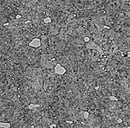
By comparing the pictures on the page about purity it is easy to see the large primary carbides of the 440 type steel and the fact that there are no such carbides in our 12C27 in the picture right.
These large primary carbides have a diameter of up to 40 microns compared to the maximum carbide size of our 14C28N / 13C26 / 12C27 / 12C27M / 7C27Mo2 which is 2 microns (average is 0.5 microns). The impact on the edge from these primary carbides is shown in the pictures below.
 "Fig 1. A used knife edge in a steel of 440 type."
 "Fig 2. A similar edge made of Alleima® 12C27."
The knife edge with large carbides (Figure 1 above) will be much more difficult to regrind and it will be more or less impossible to grind this steel to the razor sharpness achievable with our fine-grain steels (Figure 2 above).
 Alleima® 12C27 before (to the left) and after hardening (to the right) Alleima® 12C27 before (to the left) and after hardening (to the right) |
 Grain boundary carbide web due to slow quench (500x) Grain boundary carbide web due to slow quench (500x) |
 Powder steel grade 1.05%C 14%Cr 4%Mo Powder steel grade 1.05%C 14%Cr 4%Mo |
 Powder steel grade 1.45%C 14%Cr 2%Mo 4%V Powder steel grade 1.45%C 14%Cr 2%Mo 4%V |
 Steel grade 1.05%C 14%Cr 4%Mo Steel grade 1.05%C 14%Cr 4%Mo |
 Steel grade 1.07%C 17%Cr 1%Mo 1.5%Co Steel grade 1.07%C 17%Cr 1%Mo 1.5%Co |
 Alleima® 12C27 knife steel Alleima® 12C27 knife steel |
 Alleima® 13C26 knife steel Alleima® 13C26 knife steel |
 Steel grade ASTM 440C Steel grade ASTM 440C |
 Steel grade D2 Steel grade D2 |
 |