このページは英語版のみです。 (This page is only available in English)

Corrosive environments

Sanicro® 35 is most suitable in wet corrosion environments. The advanced alloy composition not only enhances resistance to a wide range of corrosive agents - including chlorides, sulfuric, hydrochloric, and nitric acids - but also ensures stability in challenging applications exposed to wet environments.
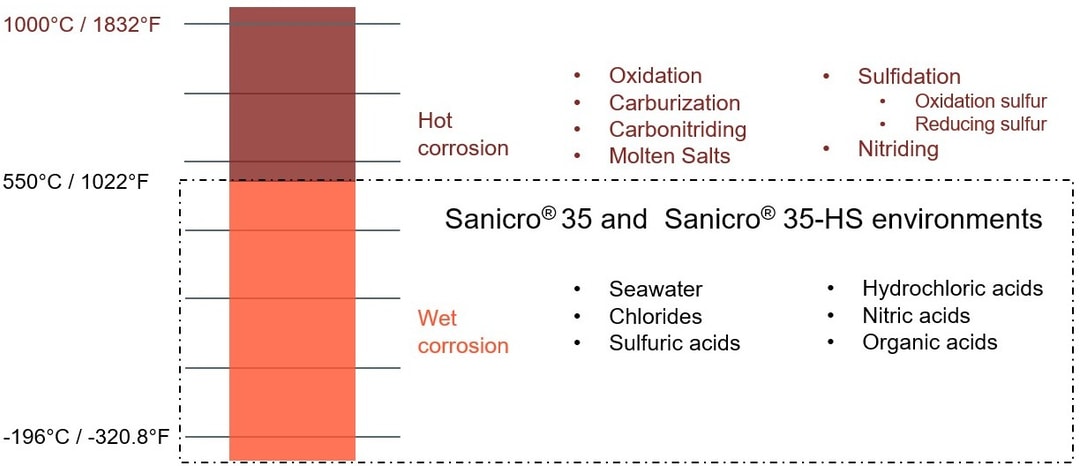
a chart of different types of corrosion

Hydrogen Induced Stress Cracking

Sanicro® 35 and hydrogen embrittlement

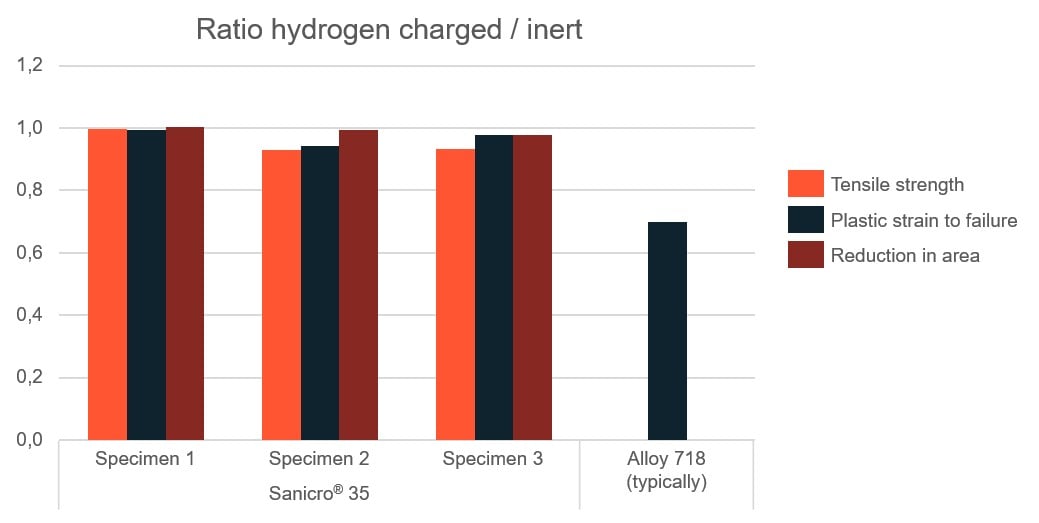
To assess the susceptibility of Sanicro® 35 to hydrogen embrittlement, Slow Strain Rate Testing (SSRT) was conducted in accordance with NACE TM0198 Method C on bar material cold-drawn to 180 KSI. The results indicate that Sanicro 35 demonstrates superior performance compared to Alloy 718. Ductile fractures and ratios close to one indicate that no hydrogen embrittlement occurred at the 180 Ksi strength level. The observed ratios for Sanicro® 35 are much higher than those for age-hardened Alloy 718.

HISC is a known issue for precipitation hardened materials like Alloy 718, Alloy 925, Alloy 625 Grade 2 etc.

a graph of different colored bars

Pitting corrosion resistance

Sanicro® 35 has a pitting resistance equivalent, PRE of 52, which makes it very resistant to general and localized corrosion. Therefore to provoke pitting, a test was conducted where the ASTM G150 test was modified to be more aggressive than the standard test, using 3 mol/l of magnesium chloride, instead of just 1 mol/l sodium chloride. This also increase the boiling point, which even more increase the severity of the test environment.

Sanicro® 35 has also been assessed in a range of corrosive environments and demonstrated particularly strong performance compared to Alloy 625.

a graph of different colored bars

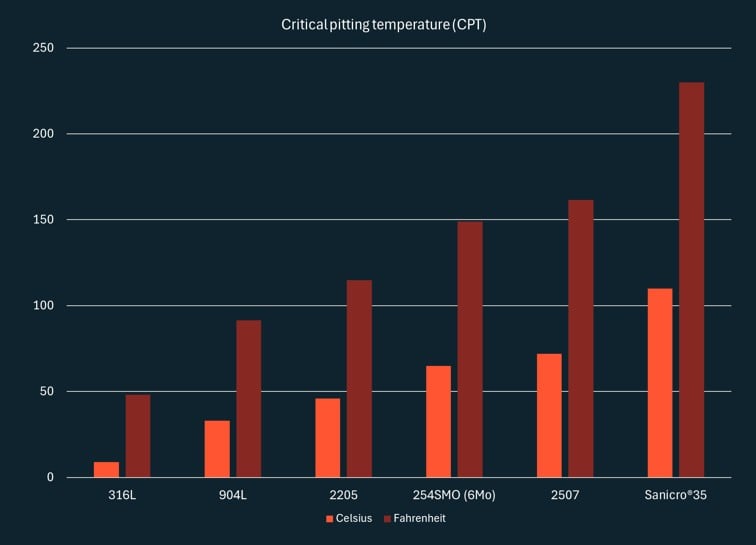
The diagram above presents the critical pitting temperature (CPT) evaluated in a modified ASTM G150 (3 M MgCl2) test. This corrosion test media is normally not used for Nickel alloys, therefore compared against austenitics/super austenitics and duplex/super duplex materials.

a graph of different colored bars

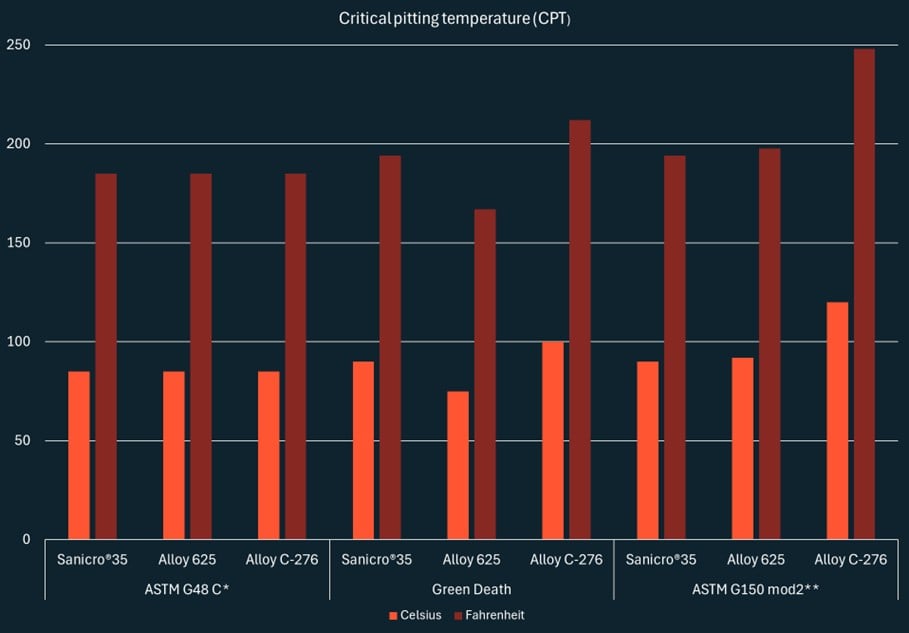
The diagram above presents the critical pitting temperature (CPT) determined across three different corrosive environments:

  • ASTM G48 method C: 6% FeCl3 + 1% HCl
  • Green Death: 11.5% H2SO4 + 1.2% HCl+ 1% FeCl3 + 1% CuCl2
  • ASTM G150 (modified): 4.5 M MgCl2 pH 5

Crevice corrosion resistance

Critical Crevice Temperature (CCT)

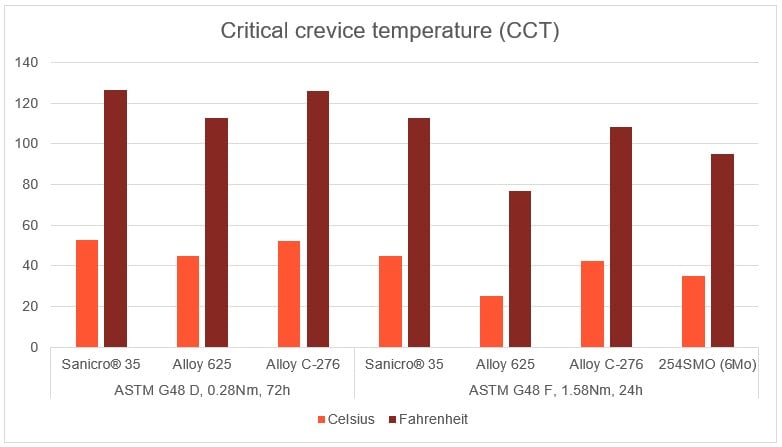
Sanicro® 35 has undergone testing and evaluation in accordance with ASTM G48 methods D* and F*. The results confirm outstanding resistance to crevice corrosion across demanding environments.

*The ASTM G48 described methods are​

  • D for Nickel alloys​
  • F for Stainless Steel

As a bridging alloy between stainless steels and nickel-based alloys, Sanicro® 35 has been evaluated against both standards. The results demonstrate its broad application range and reliable performance in highly corrosive conditions.

a graph of different types of crevices

Seawater corrosion resistance

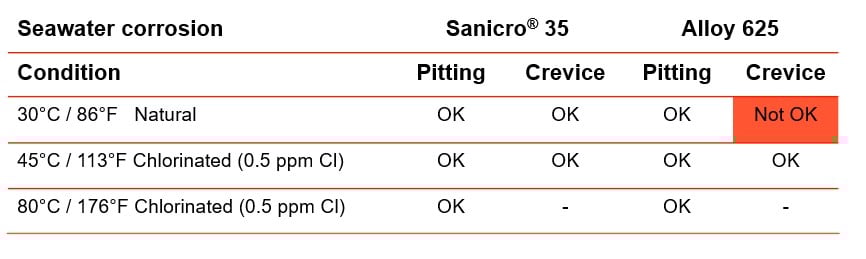
Sanicro® 35 demonstrates superior performance in natural seawater, outperforming Alloy 625. Around 30°C represents one of the most severe seawater conditions, where elevated temperature and aggressive chlorides increase the risk of localized corrosion such as pitting and crevice attack.

Natural seawater at 30°C / 86°F

  • Sanicro® 35 has excellent pitting and crevice corrosion resistance.
  • Sanicro® 35 has better crevice corrosion resistance than Alloy 625.

Chlorinated seawater

  • Sanicro® 35 is resistant to crevice corrosion at 45ºC / 113ºF.
  • Showed excellent resistance to pitting corrosion at 80ºC / 176ºF.

a close-up of a list of text

The table above summarizes seawater test results for Sanicro® 35 and Alloy 625. In addition, Sanicro® 35-HS demonstrates superior performance compared with Alloy 718, an alloy known to face challenges in these environments.

Sour service

H2S testing - ANSI/NACE MR0175/ISO15156

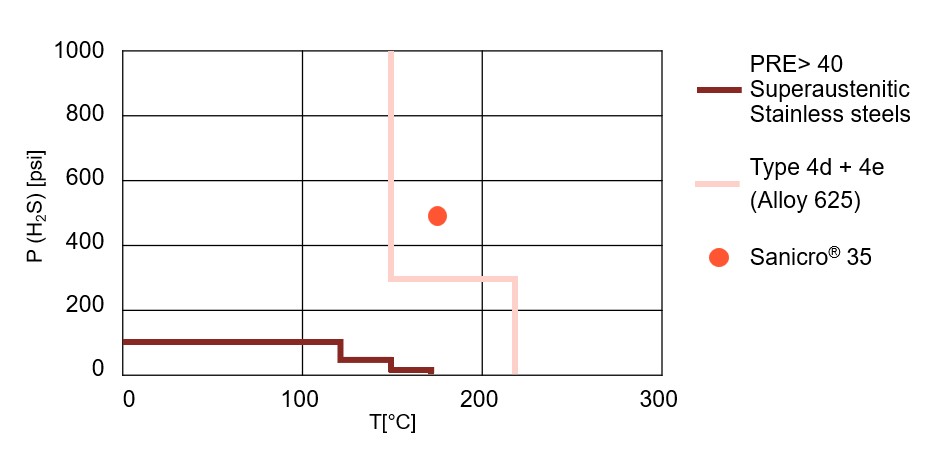
Sanicro® 35 fulfills NACE requirements for hydrogen sulphide service. Testing was conducted at NACE Test Level VI (500 psi H₂S and 500 psi CO₂, 20 wt-% NaCl at 175 °C), which is significantly more severe than the limits specified for higher-alloyed Type 4d and 4e materials.

Test results from cold-worked tubes with Rp0.2 of 140 ksi and 180 ksi confirm that Sanicro® 35 maintains integrity and reliability under these stringent conditions, supporting its suitability for demanding sour service applications.

a graph of a temperature

The table presents the test results for Sanicro® 35 in comparison with the specified limits outlined in tables A.9 and A.14 of ANSI/NACE MR0175/ISO15156-3.

Want to know more? We're here to help