このページは英語版のみです。 (This page is only available in English)

Sanicro® 35 is a next‑generation alloy, developed and patented by Alleima, engineered to set a new benchmark in highly corrosive environments.

The development of Sanicro® 35 began with a clear industry challenge. Conventional duplex and austenitic stainless steels could not deliver the required performance, while nickel‑based alloys are often too costly. Alleima set out to close this critical materials gap with a solution that combines high performance with cost efficiency.

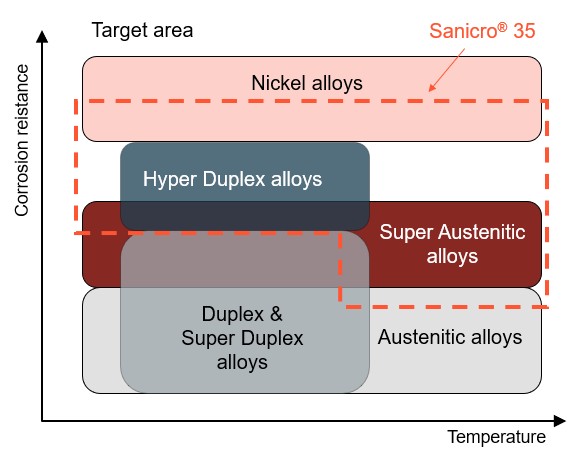
Target Area
a diagram of different types of duplex

Features

  • Combines the best features of a super
    austenitic stainless steel and a nickel alloy
  • Performance that can match
    several nickel-based materials

Possibilities

  • Cost effective solution to nickel alloys
  • Upgrade possibilities vs. current super austenitic and duplex stainless steels

A Metallurgical Breakthrough

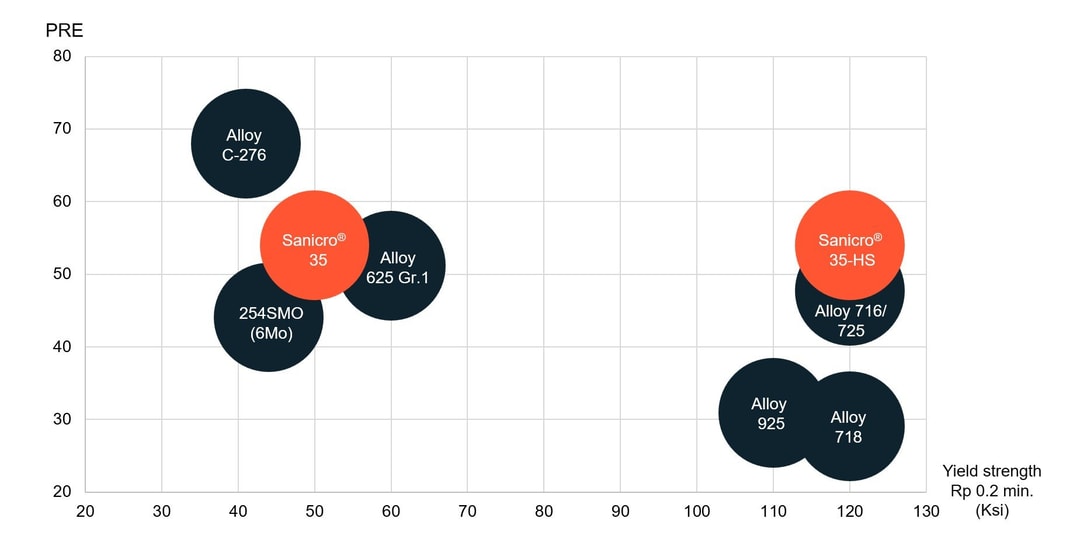
To achieve this performance the Alleima R&D team optimized the chemical composition, resulting in a PRE value of 52. This engineered chemistry delivers reliability in demanding applications where material failure is not an option.

The Result

Sanicro® 35 stands as a unique alloy that bridges the gap between stainless steels and nickel‑based alloys - offering the strength, corrosion resistance, and stability of premium materials at a competitive total cost of ownership.

One alloy.

Two delivery conditions.

A wide range of strength options - without compromising corrosion resistance.

Sanicro® 35 bar is currently available in the annealed condition, with a cold‑drawn version under development, enabling optimization of strength to meet application requirements while maintaining the same chemical composition and corrosion performance.

Alleima bar product offering

白地に銀の円柱

Sanicro® 35

Sanicro® 35 bar offers exceptional corrosion resistance in its fully annealed condition. With a minimum yield strength of 350 MPa (50 Ksi), it provides a strong and reliable alternative to Alloy 625 in a wide range of applications. The annealed bars are also highly suitable for cold drawing, enabling further enhancement of mechanical properties while maintaining the alloy’s excellent corrosion resistance.

青い布張りの箱

Sanicro® 35-HS

Sanicro® 35-HS bar is an upcoming high strength bar grade developed to provide greater flexibility in meeting application specific strength requirements. It is engineered with a starting minimum yield strength of 830 MPa (120 Ksi) - making it comparable to Alloy 718. The grade is currently undergoing validation in close collaboration with industry partners and is planned for market introduction in 2027.

a close up of water

Sanicro® 35 performs at a level where even chlorinated, warm, or splash-zone seawater is not a problem; behaves like a nickel alloy without the nickel-alloy price tag

Sanicro® 35 bar grade positioning

a graph with numbers and circles

Compared to other super austenitic grades, Sanicro® 35 reliably ranks at the top of the super‑austenitic category with a PRE above 52. In its cold-drawn form, its yield strength can surpass that of standard nickel alloys, offering the advantages of both types of materials.

Sanicro® 35 bar vs other grades

テキスト付きグラフのグラフ

Sanicro® 35 bar​ vs.​ Alloy 625 Grade 1

At 30 °C (86 °F) in natural seawater, Sanicro® 35 bar delivers corrosion performance at least on par with Alloy 625 Grade 1. For dimensions above 4 inches, both materials meet the minimum yield strength requirement of 350 MPa (50 Ksi). Sanicro® 35 provides a more cost efficient and lower carbon alternative then Alloy 625, thanks to its optimized nickel content and non remelted production route. In addition, Sanicro® 35 exhibits substantially higher impact strength.

異なるタイプのプロパティのグラフ

Sanicro® 35 bar - vs. Alloy C-276

Both Sanicro® 35 and Alloy C-276 offer exceptional corrosion resistance across challenging chloride rich and aggressive environments. Sanicro® 35 combines this resilience with higher mechanical strength and superior machinability - providing a robust and cost-efficient alternative with optimized alloy content. Alloy C-276 remains a benchmark for extreme pitting resistance, but Sanicro® 35 brings a powerful balance of performance, durability, and value.

グラフのスクリーンショット

Sanicro® 35 bar - vs. 254SMO (6Mo)

Sanicro® 35 delivers a step change in performance compared to 254SMO (6Mo), offering markedly higher crevice and pitting corrosion resistance together with stronger mechanical properties. While both grades provide robust corrosion protection, 254SMO stands out with slightly better machinability, whereas Sanicro® 35 delivers superior overall performance in critical applications.

グラフのスクリーンショット

Sanicro® 35-HS bar - vs. Alloy 718

Sanicro® 35-HS delivers excellent crevice corrosion resistance and is virtually immune to HISC (Hydrogen Induced Stress Cracking). In contrast, Alloy 718, as a precipitation hardened nickel alloy, is well documented to suffer from HISC in wet, chloride containing environments such as natural seawater. As a result, Sanicro® 35-HS exceeds the performance of Alloy 718 in wet corrosion applications, while maintaining comparable strength levels.

抵抗のタイプ別チャート

Sanicro® 35-HS bar - vs. Alloy 716/725

Alloy 716/725 has demonstrated a similar susceptibility to HISC (Hydrogen Induced Stress Cracking) as Alloy 718, reinforcing Sanicro® 35-HS as a strong and reliable alternative in applications where hydrogen related cracking must be tightly controlled. With its lower total alloying content, Sanicro® 35-HS also provides a more cost efficient solution with a reduced carbon footprint, without compromising performance.

グラフのスクリーンショット

Sanicro® 35-HS bar - vs. Alloy 925

Sanicro® 35-HS provides outstanding resistance to Hydrogen Induced Stress Cracking (HISC), as well as crevice and pitting corrosion in chloride rich environments, delivering a higher overall pitting resistance equivalence (PRE) then Alloy 925. Sanicro® 35-HS has a slightly higher tensile strength than that of Alloy 925 but Sanicro® 35-HS further differentiates itself through superior flexibility and its ability to undergo extensive cold working to achieve targeted tensile properties. Both grades offer the same level of machinability.

Want to know more? We're here to help